

 +91-11-41255444
 info@holylandgroup.com
Blog
Curating Imported Food Gourmet for Modern Foodservice
A chef in a Bengaluru kitchen picks up the lid off a pan of red curry and the steam that emanates, smells like Bangkok. No, not because the chef was from Thailand, but because the paste in that pan started its life on a farm in Thailand weeks ago. What does it actually take for a flavour like that to travel thousands of kilometres and still taste like it should while being plated for a customer who has no idea about any of it? That question sits at the centre of modern foodservice sourcing. Curating global flavours isn't just a culinary skill anymore. It's part of the supply chain.
What's Imported, and How It Actually Makes a Difference
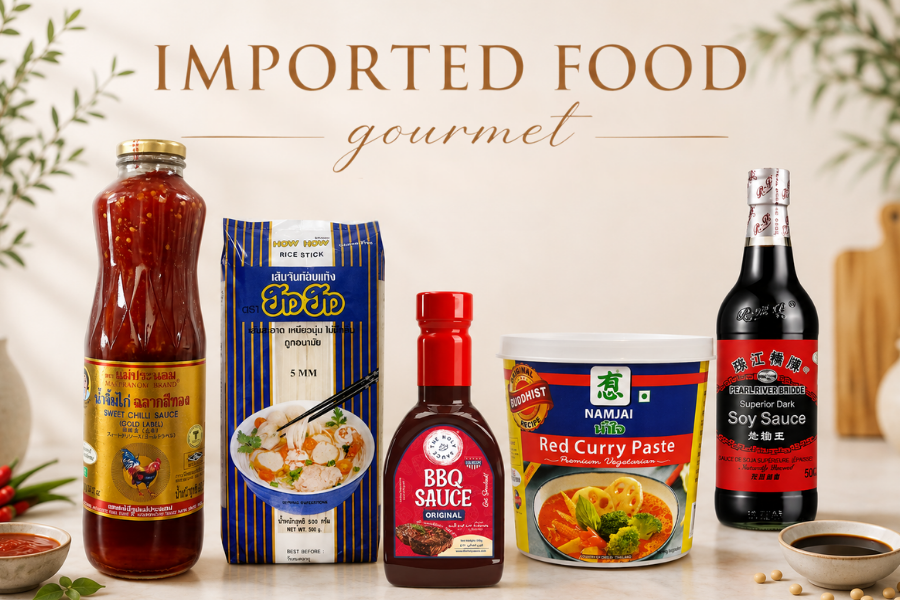
Walk through an imported gourmet range and you'll find rice vermicelli, rice vinegar, sesame and blended oils, and a full spread of Thai curry pastes, red, green, panang, matsaman, alongside soy sauces from brands like Golden Crown, Euro Gold, River Pearl Bridge, Namjai, Maepranom, and Star Lion. None of that is decoration on a menu. It's the difference between a curry that tastes authentically Thai and one that tastes like someone's best guess at Thai using a domestic curry powder.
Consistency is important, as much as authenticity. An all india chain of restaurants needs the same paste to taste the same way in June and December, in Delhi and in Bengaluru. That's why imported gourmet products earn their place with HoReCa operators. And "imported" doesn't mean for months losing its zing. It's usually freshly processed at or near the point of origin, sealed properly, and moved through a controlled chain. These ingredients arrive tasting close to how they tasted the day they were made.
From Italy to India, How Global Ingredients Inspire Indian Menus
Fusion menus across Indian cities are proof this works both ways. Pasta ranges show up next to tandoori plates. Pan-Asian sauces get folded into distinctly Indian preparations. Why import a sauce at all, when a kitchen could try to recreate it locally? Because some flavours just don't translate. A dark soy sauce built on a specific fermentation process isn't something you replicate with substitutes on a Tuesday afternoon. Chefs use these imports as a starting point, a real one, and build Indian ideas on top of it.
Gourmet Doesn't Mean Complicated
I’ve heard people say that gourmet ingredients are expensive, fussy and only for chefs. That's not true. They are curated to simplify kitchen life. A red or green curry paste cuts the prep time significantly and keeps the food consistent. These things matter enormously for QSR chains and cloud kitchens trying to scale across cities. Complicated ingredients and processes always get beaten by simple ingredients used well, every time.
The Journey of an Imported Ingredient
Take the Green curry paste. It starts with galangal, chilli, lemon grass, thai basil, basically all things flavourful. These ingredients are then ground and processed without losing their flavour or fragrance in a unit in Thailand. Once the paste is the desired texture and consistency, it is immediately packaged in the same facility and sealed to hold its freshness. Then the trip to India begins. Travels by sea and then at a warehouse it gets checked and cleared for distribution. From there it reaches the restaurants, hotels and cloud kitchens across cities. A chef then uses this paste to create its signature Green curry which its customers enjoy for the taste and fragrance which takes them back to Thailand.
The customer never really sees the process of preparation or the transportation or the distribution. They are just looking for the right taste. And that's the whole job!!
they are sitting in a container ?
like in the container yards! shipment comes in containers. do you need me to change it?
Featured Articles
North Indian
 Back
Back